End-of-Day Drawdown Explained, With a Worked Example
End-of-day drawdown only moves when the session closes. A day-by-day example, when it stops trailing, and why it's now the futures norm.
By Prop Firm Duel · · updated Sep 27, 2026
End-of-day drawdown is a loss limit that only moves when the trading session closes. If you close the day at a new high, your floor rises by the same amount. During the day it stays put, so a winning trade that pulls back doesn't cost you room.
Key takeaways
- End-of-day drawdown uses your closing balance, not your intraday peak.
- It is the most common type in futures: 33 of 38 programs we track with a published type use it.
- Your floor can still be hit during the day. It just doesn't rise during the day.
- At many firms, the floor stops trailing once it reaches a set lock level.
What is end-of-day drawdown?
End-of-day drawdown, often shortened to EOD drawdown, measures your highest closing balance and keeps your floor a fixed distance below it. On a 50K account with a $2,000 EOD drawdown, the floor starts at $48,000. Each time you close a session at a new high, the floor follows it up.
The key word is closing. Open profit during the day doesn't move the floor, which is what separates this rule from intraday trailing drawdown.
How does end-of-day drawdown work, step by step?
Here is one week on a 50K account with a $2,000 end-of-day drawdown:
| Day | Intraday high | Closing balance | Floor for the next day |
|---|---|---|---|
| Start | — | $50,000 | $48,000 |
| Monday | $51,400 | $50,900 | $48,900 |
| Tuesday | $51,200 | $50,400 | $48,900 |
| Wednesday | $52,100 | $51,800 | $49,800 |
| Thursday | $51,900 | $51,100 | $49,800 |
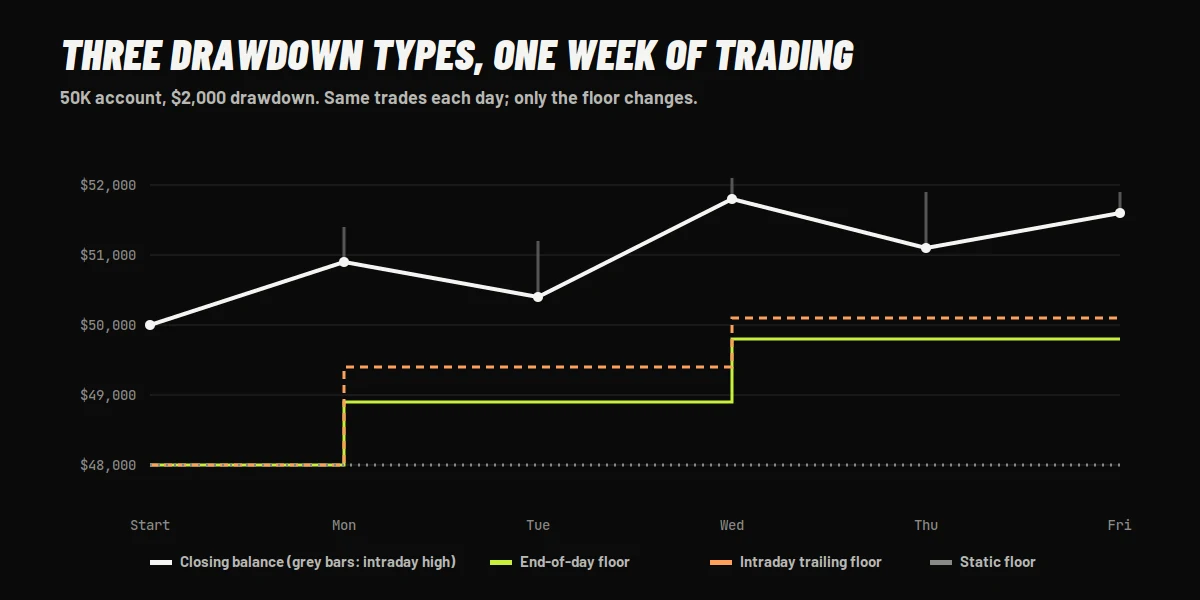
Notice Tuesday. The account closed lower than Monday, so the floor didn't move at all. Notice Monday too: the intraday high of $51,400 was ignored, because only the $50,900 close counted.
Can you hit the floor during the day?
Yes, and this is the part traders miss. The floor doesn't rise during the day, but your balance is still checked against it in real time. If Thursday's floor is $49,800 and a trade drops your balance to $49,800 at 10 a.m., the account ends at 10 a.m. End-of-day describes when the floor moves, not when it's enforced.
When does the drawdown stop trailing?
Many firms lock the floor once it reaches a set level, often your starting balance or slightly above it. After that, it stops rising, and your drawdown works like a static limit. On a 50K account, a lock at $50,000 means that once you've closed above $52,000, the floor stays at $50,000 for good. Look for the words "lock", "stop trailing" or "initial trail balance" on the firm's rules page.
How common is end-of-day drawdown?
Very common in futures. When we checked on September 26 and 27, 2026, 33 of the 38 futures programs with a published drawdown type used end-of-day drawdown. On 50K accounts, 31 of 34 programs set the amount at $2,000. See every program with this rule on our list of end-of-day drawdown prop firms.
Who is end-of-day drawdown best for?
It suits traders who hold winners for larger moves, because a pullback in open profit doesn't cost them room. It also suits traders who scale out of positions, since only the final close matters. The trade-off is that one losing day still lands on your balance, and at some firms a separate daily loss limit applies on top.
Common questions
What time counts as the end of day?
Each firm defines its own session close, usually tied to the futures session. Check the firm's rules for the exact time and time zone.
Is end-of-day drawdown better than intraday?
For most traders, yes, because open profit can't raise the floor. Prop firm drawdown rules compares all three types on the same trades.
Does it use balance or equity?
The floor is set from your closing balance. Your live balance, including open losses, is what gets checked against it during the day.
How we got these numbers
Figures come from each firm's published rules, reviewed by a person and dated September 26–27, 2026. Rules change, so confirm them on the firm's site. See our methodology.
Futures trading involves substantial risk of loss and is not suitable for everyone. Prop firm evaluations and most funded accounts trade in a simulated environment, and payouts depend on meeting each firm's rules. Everything on this site is general education, not financial advice. Rules and prices change: always read the firm's current terms before you buy. We have no affiliate or paid relationship with any firm listed. Our disclosure.