Prop Firm Drawdown Rules: End-of-Day, Intraday and Static
Drawdown is the most you can lose before a prop firm account ends. How the three types work, what's typical by account size, and how to size your trades to them.
By Prop Firm Duel · · updated Sep 27, 2026
A prop firm's drawdown is the most you can lose before the account ends. It comes in three types: end-of-day, intraday trailing and static. The type matters as much as the amount, because it decides when your loss limit moves and whether open profit counts against you.
Key takeaways
- Drawdown is the line your balance can't touch. Touch it, and the account ends.
- End-of-day drawdown moves only at the close. Intraday trailing drawdown moves with your open profit.
- 45 of the 52 futures programs we track that publish a drawdown type use end-of-day drawdown.
- On a 50K futures account, 31 of 34 programs set the drawdown at $2,000.
- Daily loss limits and consistency rules sit on top of drawdown, so read all three together.
What is drawdown at a prop firm?
Drawdown is the maximum amount your account can fall before the firm closes it. Firms also call it the max loss limit, the trailing threshold or the liquidation level. Whatever the name, it works as a floor under your balance.
That floor is how a prop firm controls its risk. Your evaluation fee is small next to the account size, so the firm needs a hard stop that ends a losing account early. Every other rule is built around it, which is why drawdown is the first rule to read before you buy.
What are the three types of drawdown?
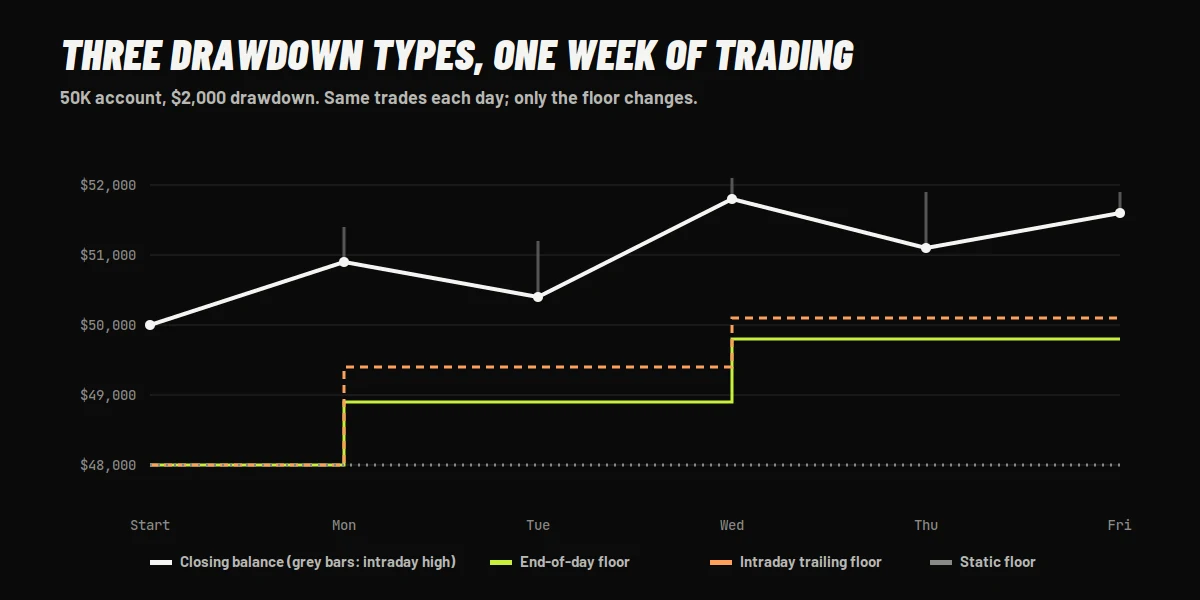
The three types differ in one thing: when the floor moves. That single difference changes how you can trade.
End-of-day drawdown
End-of-day drawdown checks your balance when the session closes. If you closed at a new high, the floor moves up by the same amount. During the day, the floor stays where it was, so a winning trade that pulls back doesn't hurt you. End-of-day drawdown explained works through a full example.
Intraday trailing drawdown
Intraday trailing drawdown follows your highest balance in real time, including open profit. If a trade is up $1,000 before it comes back, your floor has already moved up $1,000. That makes it the strictest type for traders who let winners run. Intraday trailing drawdown explained shows how to trade around it.
Static drawdown
Static drawdown never moves. On a 50K account with a $2,000 static drawdown, the floor sits at $48,000 no matter how much you make. It is common in forex, and rare in futures.
Which drawdown type is most common?
In futures, end-of-day drawdown is now the norm. Here is what the programs in our data showed when we checked them on September 26 and 27, 2026:
- Type: 33 of 38 futures programs with a published type use end-of-day drawdown, and 5 use intraday trailing.
- 25K accounts: 25 of 28 programs set drawdown at $1,000.
- 50K accounts: 31 of 34 set it at $2,000.
- 100K accounts: 24 of 34 set it at $3,000.
- 150K accounts: 16 of 29 set it at $4,500.
Because the amounts are so similar, the type is usually what separates one program from another. Two 50K accounts with the same $2,000 drawdown can feel completely different to trade.
A worked example on a 50K account
Say you start a 50K account with a $2,000 drawdown, so your floor begins at $48,000. On Monday, a trade runs to $51,500 in open profit, then you close it at $51,000.
- End-of-day: you closed Monday at $51,000, so the floor moves to $49,000. You have $2,000 of room on Tuesday.
- Intraday trailing: your peak was $51,500, so the floor moved to $49,500. You have $1,500 of room on Tuesday.
- Static: the floor stays at $48,000. You have $3,000 of room.
The trade was identical in all three cases. Only the rule changed, and it cost the intraday trader $500 of room.
Does the drawdown ever stop trailing?
At many firms, yes. Once the floor rises to a set level, often your starting balance or slightly above it, it locks and stops moving. From then on, it behaves like static drawdown. The lock level is one of the most useful numbers on a firm's rules page, and it varies more than the drawdown itself.
How do other loss rules work with drawdown?
Drawdown is the main limit, but two more rules often sit on top of it.
The daily loss limit caps what you can lose in one day. At some firms it pauses trading until tomorrow, and at others it ends the account. See the daily loss limit explained.
The consistency rule limits how much of your profit can come from your best day. It doesn't end the account, but it can delay a pass or a payout. See the prop firm consistency rule.
Firms also set contract limits and sometimes news trading rules. None of these replace drawdown, so read them as one set.
How to size your trades to your drawdown
Size every trade to the drawdown first, and to the contract limit second. A simple rule of thumb is to risk no more than a tenth of your drawdown on one trade. On a $2,000 drawdown, that is $200, which is 100 points on one micro Nasdaq contract or 10 points on one mini, since the mini is worth ten times as much. Micro vs mini contracts explains the math.
That buffer gives you about ten losing trades in a row before you reach the floor. It is not the only way to size, but it keeps one bad day from ending the account.
How to find a firm's drawdown rule
Every firm page on Prop Firm Duel lists each program's drawdown type and amount by account size, with a link to the firm's own rules. You can also filter by type: see end-of-day drawdown prop firms or prop firms with no daily loss limit.
Common questions
Which drawdown type is best?
For most day traders, end-of-day drawdown is the most forgiving, because intraday swings don't move the floor. Static drawdown is even simpler but rare in futures.
Does drawdown include open trades?
Your floor is always checked against your live balance, including open losses. With intraday trailing drawdown, open profit also raises the floor.
What happens if I hit the drawdown?
The account ends. In an evaluation, you can usually reset for a fee or buy a new one. See what to do after a failed challenge.
Is drawdown the same in the evaluation and funded account?
Usually, yes, though some firms change the type or lock level once you're funded. Read both sets of rules.
How we got these numbers
Every figure here comes from the rules each firm publishes on its own website or help center, reviewed by a person and dated. Firms change their rules often, so confirm the current terms on the firm's site. Our methodology explains how we check the data.
Futures trading involves substantial risk of loss and is not suitable for everyone. Prop firm evaluations and most funded accounts trade in a simulated environment, and payouts depend on meeting each firm's rules. Everything on this site is general education, not financial advice. Rules and prices change: always read the firm's current terms before you buy. We have no affiliate or paid relationship with any firm listed. Our disclosure.