What Is a Prop Firm? How Prop Firms Work (2026)
A prop firm lets you trade its account for a fee and a share of the profits. How the four steps work, what it costs, and the rules that decide whether you keep the account.
By Prop Firm Duel · · updated Sep 27, 2026
A prop firm, short for proprietary trading firm, lets you trade its account instead of your own money. You pay a fee for an evaluation, trade under the firm's rules, and if you pass, you trade a funded account and keep most of the profit. If you break a rule, the account ends and you lose the fee, not your savings.
Key takeaways
- A prop firm sells you an evaluation. Pass it, and you trade the firm's account for a share of the profit.
- The loss limit, called drawdown, decides whether you keep the account. Read it first.
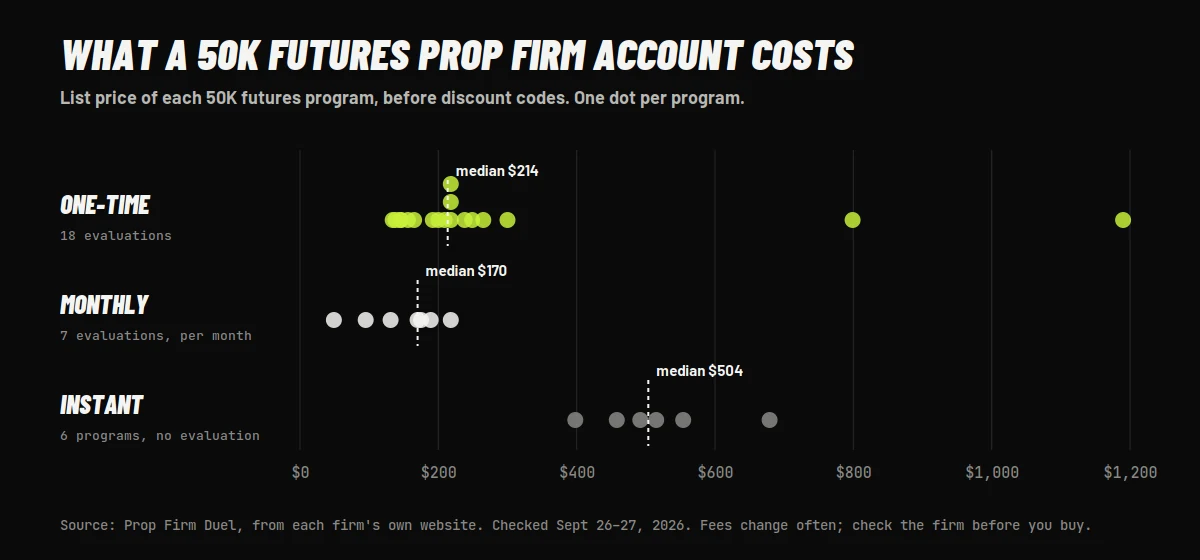
- Across the futures programs we track, a 50K evaluation has a median list price of about $214 one-time or $170 a month.
- At many firms the funded account is simulated, and the firm pays you from its own money.
- Most evaluations end without a payout, so budget for more than one attempt.
What is a prop firm?
A prop firm is a company that gives traders access to a large account in exchange for a fee and a share of the profits. Instead of depositing $50,000 of your own money, you pay a few hundred dollars for the chance to trade a $50,000 account. That trade-off is the whole appeal: your risk is capped at what you pay the firm.
The name comes from Wall Street, where proprietary trading means a firm trading its own capital for its own profit. The prop firms most traders search for today work differently. They are open to anyone online, they sell evaluations to the public, and they pay traders who pass. When people say "prop firm" in 2026, this online model is usually what they mean, and it is the model this guide explains.
How do prop firms work?
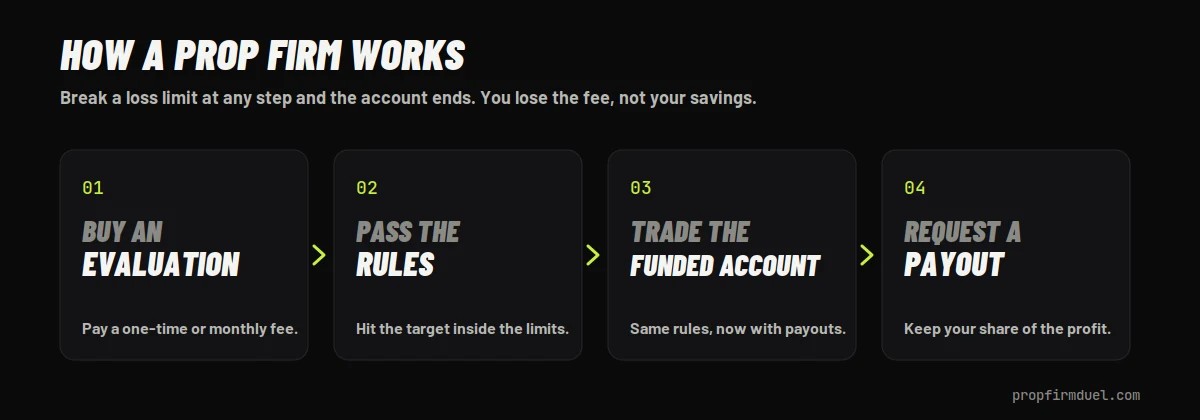
Almost every prop firm follows the same four steps. The names change from firm to firm, but the order does not.
Step 1: Buy an evaluation
You start by choosing an account size, such as 25K, 50K or 150K, and paying for its evaluation. Some firms charge once, and others charge every month until you pass. Our guide to one-time vs monthly prop firms shows which billing model costs less for different traders.
Step 2: Pass the rules
The evaluation, sometimes called a challenge, asks you to reach a profit target without breaking a loss limit. On a 50K futures account, that usually means making $3,000 without losing $2,000 from your high point. Some firms add a daily loss limit, a minimum number of trading days or a consistency rule on top. How prop firm evaluations work walks through each rule.
Step 3: Trade the funded account
Once you pass, you move to a funded account. Some firms charge an activation fee at this point, though most of the futures programs we track do not. The funded account keeps the same loss limit, so the discipline that got you through the evaluation still decides whether you stay.
Step 4: Request a payout
From the funded account, you can ask to be paid. Your share is called the profit split, and 80% or 90% is the most common. Before a firm pays, it usually checks for a minimum number of trading days, a profit buffer and a clean record on its rules. How prop firm payouts work covers every condition.
What the numbers look like
Every rule on Prop Firm Duel comes from the firm's own website or help center, reviewed by a person. Taken together, those rules show what a typical prop firm actually asks of you. Here is what the futures programs in our data looked like when we last checked them on September 26 and 27, 2026:
- Drawdown: 33 of the 38 programs with a published drawdown type use end-of-day drawdown. The other 5 trail in real time during the day.
- Loss limit on a 50K account: 31 of 34 programs set it at $2,000.
- Profit target on a 50K account: 28 of 29 programs ask for $3,000.
- Activation fee: 26 of the 28 programs that publish one charge nothing to activate a funded account.
- Profit split: of the 39 programs with a published split, 17 offer 80%, 13 offer 90% and 4 advertise 100%. A split can change after a set amount, so read the conditions.
Those numbers explain why the same few rules keep showing up in this guide. They are the rules nearly every firm shares, so learning them once prepares you for almost any firm.
How much does a prop firm cost?
A 50K futures evaluation has a median list price of about $214 as a one-time fee, based on 18 programs we track. The range is wide, from about $134 to $1,190. Monthly programs run from $49 to $218 a month, with a median of $170. Instant funding, which skips the evaluation, cost $398 to $679 at 50K.
The list price is only the start, though. Discount codes often cut it sharply, while resets, activation fees and market data fees can add to it. The number that matters is what you pay across every attempt it takes to reach a payout. Our prop firm cost guide breaks down each fee, and the All-in Cost tool adds them up for any program.
How do prop firms make money?
Prop firms make most of their money from evaluation fees. That is not a secret, because the numbers are built into the model: most evaluations end before a payout, and each attempt is paid for up front.
Some firms now publish their own results, which makes this easy to see. Tradeify, for example, reports on its website that from August 2025 to July 2026, 17.2% of its evaluation accounts were completed, and 28.5% of traders who reached a funded account received a payout. Those figures come from one firm, but they show why a realistic budget covers more than one try. How prop firms make money explains the business in more detail.
Is a prop firm account real money?
At many prop firms, no. The funded account often trades in a simulated environment, and the firm pays your share of the profit from its own money. A few firms move their best traders to a live account later.
For you, the difference shows up in two places. Your payouts depend on the firm's ability and willingness to pay, and the firm's rules, not the market, decide how you are paid. That is why a firm's payout record and terms matter as much as its prices. See simulated vs live funded accounts for what to look for.
The rules that decide whether you keep the account
Most traders who lose a prop firm account lose it to a rule, not to one bad trade. Three rules cause most of those losses.
Drawdown is the maximum you can lose before the account ends. How it is measured matters as much as how big it is. End-of-day drawdown only moves when the session closes, while intraday trailing drawdown follows your open profit in real time and can end an account during a winning trade that pulls back.
The daily loss limit caps what you can lose in one day. At some firms, hitting it pauses trading until tomorrow. At others, it ends the account. Our guide to the daily loss limit shows how to tell which kind you have.
The consistency rule limits how much of your profit can come from a single day. It exists so that one lucky day cannot pass an evaluation. The prop firm consistency rule shows how to calculate it before it catches you.
Together, these three rules are covered in full in prop firm drawdown rules.
Prop firm vs trading your own account
A prop firm is not always the better choice. It trades a small, fixed cost for strict rules, while your own account trades freedom for real risk to your savings.
| Prop firm | Your own account | |
|---|---|---|
| Money at risk | The fees you pay | Your full deposit |
| Account size | 25K to 150K or more, for a fee | Whatever you deposit |
| Rules | The firm's loss limits and payout rules | Only your broker's margin rules |
| Profit | Your split, often 80% or 90% | All of it |
| Main risk | Paying for attempts that end early | Losing your own capital |
Prop firm vs personal account works through the math for different account sizes.
Types of prop firms
Prop firms differ by what you trade and by how you get funded. By market, there are futures prop firms, forex prop firms, crypto prop firms and stock prop firms. The market changes the details, such as contract limits in futures or leverage in forex, but the four steps stay the same.
By funding path, most firms use an evaluation, while some sell instant funding that skips it for a higher price and tighter rules. Types of prop firms compares every model side by side.
Who should use a prop firm?
A prop firm suits a trader who already has a tested plan and can stop trading at a fixed loss every day. The rules reward that trader, because nearly every rule is about controlling losses.
A prop firm is a poor fit for someone still learning to trade. The evaluation fee becomes the cost of lessons that a free simulator would teach for nothing. If that sounds like you, start with prop firms for beginners before you buy anything.
How to check a prop firm before you pay
Before you pay any firm, read its rules page from top to bottom and confirm five things:
- The drawdown type and amount for your account size.
- Whether a daily loss limit pauses trading or ends the account.
- Every payout condition, including trading days and buffers.
- Every fee: evaluation, reset, activation and data.
- Whether you can sign up from your country.
Every firm page on Prop Firm Duel lists these rules for each program with the date we checked them and links to the firm's own pages, so you can confirm each one yourself. The full checklist is in check a prop firm before you buy.
Common questions
Is a prop firm the same as a broker?
No. A broker holds your own money and places your trades. A prop firm sells you access to its account under its rules and shares the profits with you.
Can you lose more than the fee?
At most prop firms, no. If you break a loss limit, the account ends and you lose what you paid. Always confirm this in the firm's terms before you buy.
How long does it take to get funded?
It depends on the profit target, any minimum trading days and your own pace. Some firms let you pass in a single day, but many traders take weeks or need more than one attempt.
Do you need experience to join a prop firm?
No firm asks for a license or a track record to sell you an evaluation. The rules still reward traders who arrive with a tested plan, so experience matters even when it isn't required.
What are the best prop firms?
The best prop firm depends on your market, account size and trading style, so there is no single winner. Instead of a ranking, Prop Firm Duel lets you compare prop firms by the rules that matter to you and see every firm we track.
Are prop firm payouts taxed?
Usually, yes. How depends on where you live and how the firm classifies you. Prop firm payouts and taxes covers the basics, and a tax professional can confirm your situation.
How we got these numbers
Every figure in this guide comes from the rules each firm publishes on its own website or help center, reviewed by a person and dated. Prices are list prices before discounts. Firms change their rules often, so always confirm the current terms on the firm's site. Our methodology explains how we collect and check the data, and new terms are in the prop firm glossary.
Futures trading involves substantial risk of loss and is not suitable for everyone. Prop firm evaluations and most funded accounts trade in a simulated environment, and payouts depend on meeting each firm's rules. Everything on this site is general education, not financial advice. Rules and prices change: always read the firm's current terms before you buy. We have no affiliate or paid relationship with any firm listed. Our disclosure.